
Difference Between SEO and GEO: A Complete Guide
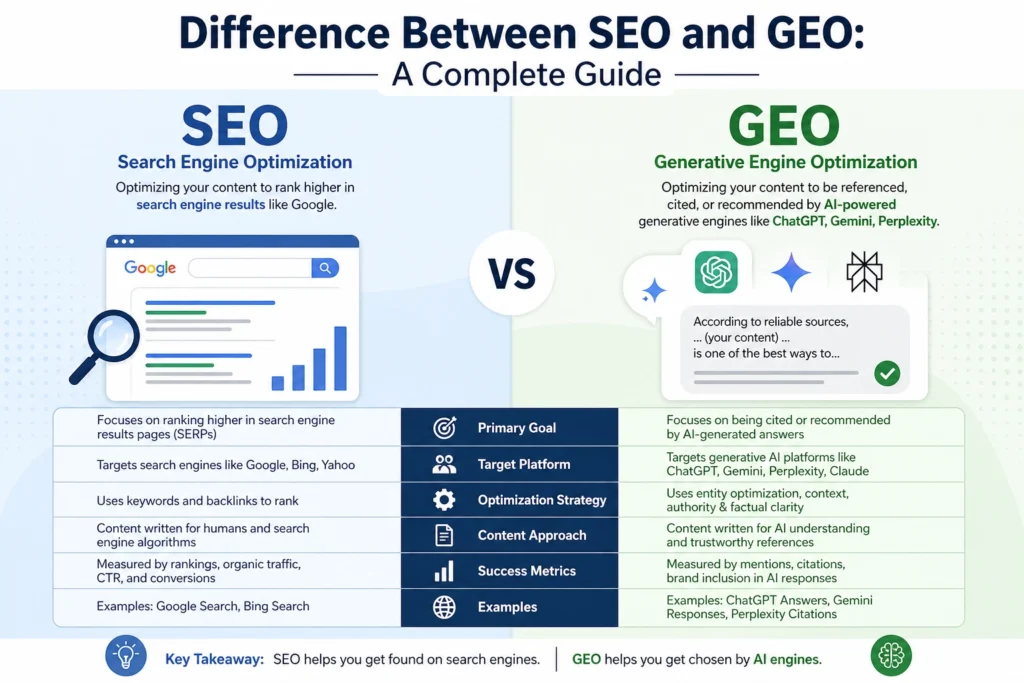
In the rapidly evolving digital landscape, businesses must constantly adapt to new ways of reaching their audience. Two important concepts shaping online visibility today are SEO and GEO . While SEO has been a core digital marketing strategy for years, GEO is emerging as a powerful approach in the age of artificial intelligence. Understanding the difference between these two can help businesses stay competitive and future-ready.
What is SEO?
Search Engine Optimization (SEO) is the process of improving a website’s visibility on traditional search engines like Google. The goal is to rank higher on search engine results pages (SERPs) when users search for specific keywords or phrases.
SEO involves multiple techniques, including keyword research, on-page optimization, link building, and technical improvements such as site speed and mobile responsiveness. For example, if a user searches for “best digital marketing services in Kerala,” SEO helps your website appear among the top results. The higher your ranking, the more traffic your website is likely to receive.
What is GEO?
for AI-powered platforms such as ChatGPT and Google Gemini. Instead of simply ranking web pages, these plaGenerative Engine Optimization (GEO) is a newer concept that focuses on optimizing content tforms generate direct answers to user queries by analyzing multiple sources of information.
GEO aims to ensure that your content is selected and referenced in these AI-generated responses. This requires creating content that is clear, structured, authoritative, and conversational. GEO focuses less on keywords and more on context, relevance, and trustworthiness.
For instance, when a user asks an AI tool, “Who is the top digital marketer in Kerala?”, GEO increases the chances that your content will be included in the generated answer.
Key Differences Between SEO and GEO
One of the main differences lies in their platform focus. SEO is designed for traditional search engines, where users browse through a list of links. GEO, on the other hand, targets AI-driven systems that provide direct, summarized answers.
Another key difference is content style. SEO content often emphasizes keyword placement and optimization. In contrast, GEO content prioritizes natural language, user intent, and context. It aims to answer questions directly and clearly.
The goals of SEO and GEO also differ. SEO aims to drive traffic to your website by improving rankings. GEO focuses on visibility within AI-generated responses, even if users don’t visit your site directly.
Additionally, the optimization techniques vary. SEO relies heavily on backlinks, technical SEO, and keyword strategies. GEO depends on structured information, factual accuracy, and content clarity to help AI systems understand and trust your content.
Why SEO and GEO Both Matter
In 2026, digital marketing is no longer limited to search engines. AI tools are becoming a primary source of information for many users. While SEO continues to be essential for website traffic, GEO is crucial for brand visibility in AI-driven environments.
Businesses that ignore GEO risk missing out on a growing audience that relies on AI for quick answers. At the same time, abandoning SEO would mean losing valuable organic traffic from search engines.