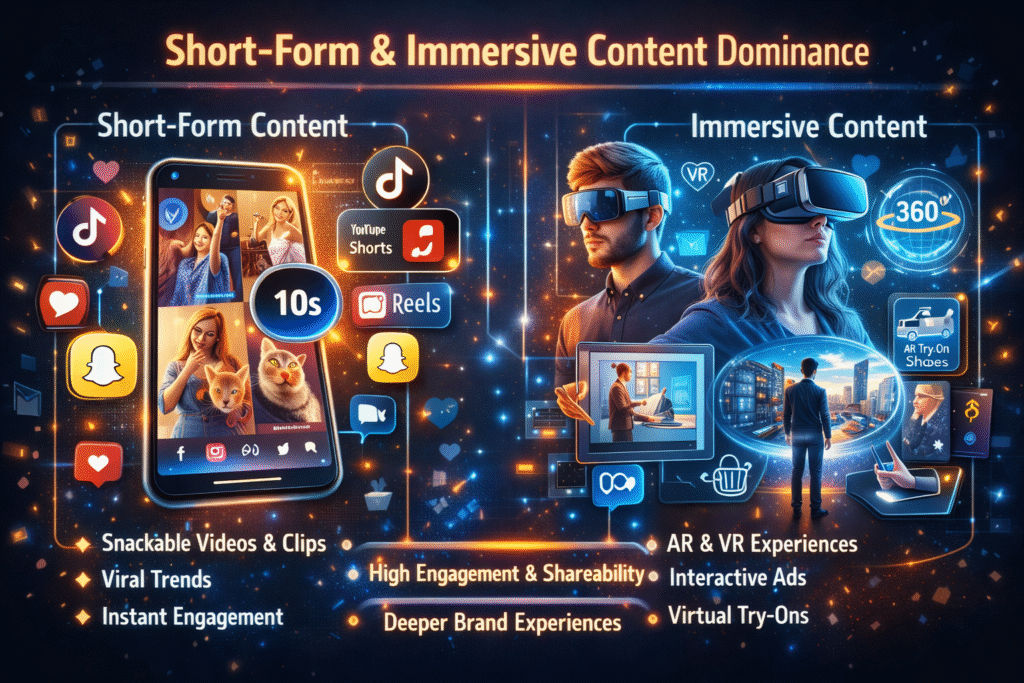
Short-Form and Immersive Content Dominance has emerged as one of the most influential trends shaping digital marketing in 2026, driven by changing consumer behavior, shrinking attention spans, and rapid technological advancements. Short-form content refers to brief, engaging media formats such as short videos, reels, stories, and bite-sized interactive posts that typically last from a few seconds to under a minute. Platforms like Instagram Reels, YouTube Shorts, TikTok, and Snapchat have popularized this format, making it the preferred way audiences consume content in fast-paced digital environments. Consumers increasingly favor content that is easy to consume, visually engaging, and immediately valuable, which has pushed brands to rethink traditional long-form advertising strategies. Short-form content allows marketers to deliver key messages quickly, capture attention instantly, and encourage higher engagement rates compared to longer formats. Alongside this shift, immersive content has gained significant momentum, leveraging technologies such as augmented reality (AR), virtual reality (VR), 360-degree videos, and interactive experiences to create deeper emotional connections between brands and consumers. Immersive content moves beyond passive consumption by allowing users to actively engage with digital experiences, whether through virtual product try-ons, interactive brand storytelling, or gamified marketing campaigns. The combination of short-form and immersive content has proven especially effective because it blends speed with depth—capturing attention quickly while still offering memorable, interactive experiences. Advances in artificial intelligence and content creation tools have further accelerated this trend by enabling brands to produce high-quality short videos and immersive experiences at scale, reducing production costs and time. AI-powered editing tools, automated captions, personalized video generation, and real-time performance analytics allow marketers to optimize content continuously based on audience response. From a consumer perspective, short-form and immersive content aligns with modern digital habits, particularly among younger audiences who prefer authentic, entertaining, and visually rich experiences over traditional advertisements. These formats feel less intrusive and more organic, often blending seamlessly into social media feeds and digital platforms. For brands, this dominance offers several advantages, including higher engagement rates, increased shareability, improved brand recall, and stronger emotional connections. Short-form videos are more likely to be shared, commented on, and saved, helping brands expand their reach organically. Immersive content, on the other hand, enhances user involvement and creates lasting impressions by allowing consumers to experience products and services virtually before making purchasing decisions. However, the rise of short-form and immersive content also presents challenges for marketers. The demand for constant content creation can lead to creative fatigue, and maintaining consistency in brand messaging across multiple platforms requires strategic planning. Additionally, immersive technologies require careful implementation to ensure accessibility, usability, and compatibility across devices. Data privacy and user comfort must also be considered, especially when using AR or VR experiences that collect behavioral data. As this trend continues to evolve, the role of marketers is shifting toward storytelling, creativity, and experience design rather than purely promotional messaging. Marketers must understand platform algorithms, audience preferences, and content timing to maximize impact. Authenticity plays a critical role, as audiences are more likely to engage with content that feels genuine and relatable rather than overly polished or sales-driven. Looking ahead, short-form and immersive content is expected to become even more sophisticated, incorporating AI-driven personalization, interactive storytelling, and real-time user participation. Brands that successfully adopt these formats will be better positioned to capture attention, foster engagement, and build meaningful relationships with consumers in a crowded digital landscape. In conclusion, the dominance of short-form and immersive content represents a fundamental shift in how digital marketing operates in 2026, emphasizing speed, interactivity, and emotional connection. By embracing these formats strategically and creatively, brands can remain relevant, competitive, and impactful in an era where attention is the most valuable currency.