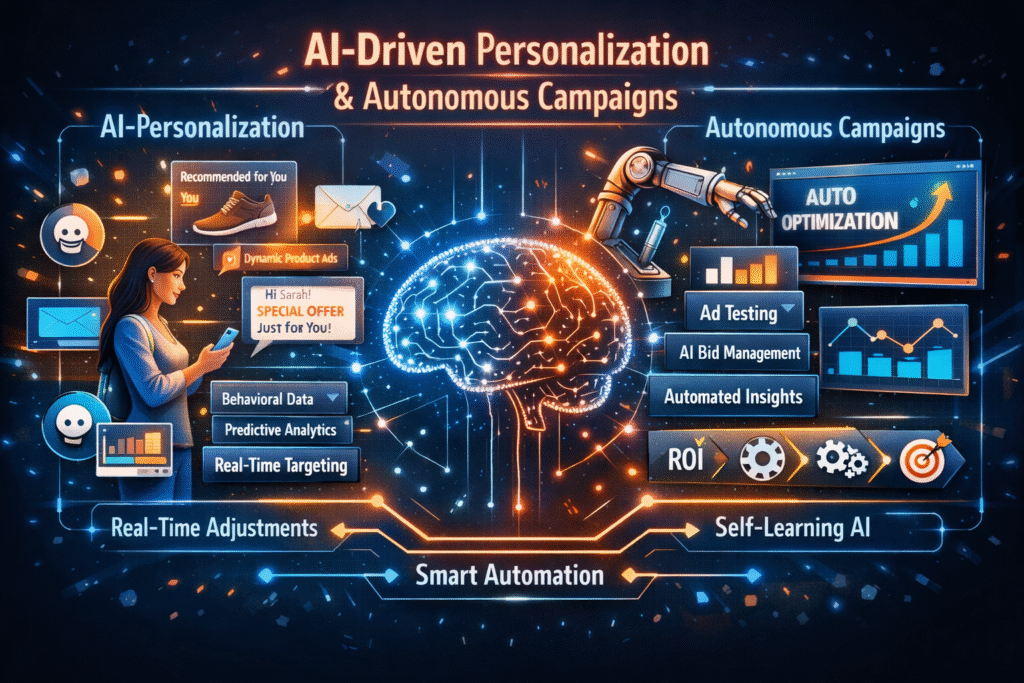
AI-Driven Personalization and Autonomous Campaigns represent one of the most transformative shifts in digital marketing as businesses move into 2026, redefining how brands interact with consumers in an increasingly data-driven environment. AI-driven personalization refers to the use of artificial intelligence technologies such as machine learning, predictive analytics, and natural language processing to analyze vast amounts of customer data and deliver highly customized content, offers, and experiences to individual users in real time. Unlike traditional personalization methods that rely on broad audience segments or basic demographic data, AI personalization examines complex behavioral patterns including browsing history, purchase frequency, interaction timing, device usage, location data, and engagement across multiple digital touchpoints. By processing these signals, AI systems can predict customer intent and preferences with remarkable accuracy, enabling brands to deliver the right message to the right person at the right moment. This approach has led to the emergence of “segment-of-one” marketing, where each consumer experiences a unique and relevant brand interaction. Alongside personalization, autonomous campaigns have become a defining feature of modern marketing strategies, allowing AI systems to manage campaigns with minimal human involvement. Autonomous campaigns are powered by self-learning algorithms that can plan, execute, monitor, and optimize marketing activities across platforms such as search engines, social media, email, and display advertising. Instead of manually adjusting budgets, targeting criteria, creatives, and schedules, marketers set clear objectives such as maximizing conversions, improving engagement, or reducing customer acquisition costs, and AI systems handle the execution. These systems continuously collect performance data, analyze outcomes, and make real-time adjustments to improve results, often responding faster and more accurately than human teams. One of the major advantages of AI-driven personalization and autonomous campaigns is their ability to scale efficiently. While traditional marketing teams struggle to manage large audiences with individualized messaging, AI can simultaneously personalize experiences for millions of users without compromising speed or accuracy. This scalability leads to improved customer experiences, as consumers increasingly expect brands to understand their needs and preferences without repeated explanations. Personalized recommendations, tailored advertisements, dynamic website content, and conversational chatbots contribute to higher engagement levels, stronger brand loyalty, and increased conversion rates. From a business perspective, autonomous campaigns enhance operational efficiency by reducing repetitive manual tasks and minimizing human error, allowing marketing professionals to focus on strategic planning, creativity, and long-term growth. However, the widespread adoption of AI-driven personalization also raises important challenges and ethical considerations. The reliance on large volumes of personal data brings concerns related to privacy, data security, and regulatory compliance, making transparency and responsible data management essential. Additionally, AI systems can sometimes operate as “black boxes,” where decision-making processes are difficult to explain, creating challenges for accountability and trust. Algorithmic bias is another risk, as AI trained on biased or incomplete data may unintentionally exclude or disadvantage certain groups of consumers. To address these issues, organizations must implement strong governance frameworks, ensure ethical AI practices, and maintain human oversight in critical decision-making processes. As AI continues to evolve, the role of marketers is also changing significantly. Rather than focusing on day-to-day campaign management, marketers are becoming strategic leaders who guide AI systems by defining objectives, brand values, and creative direction. Human insight, emotional intelligence, and ethical judgment remain essential, ensuring that AI enhances rather than replaces the human element of marketing. Looking ahead, AI-driven personalization and autonomous campaigns are expected to become even more sophisticated, incorporating emotion recognition, voice and visual intelligence, and predictive capabilities that anticipate customer needs before they are explicitly expressed. In conclusion, AI-Driven Personalization and Autonomous Campaigns are reshaping digital marketing by enabling intelligent, adaptive, and customer-centric engagement at an unprecedented scale. When implemented responsibly, these technologies empower brands to build meaningful relationships with consumers, optimize performance continuously, and remain competitive in a rapidly evolving digital landscape, making them a cornerstone of modern marketing strategy in 2026 and beyond.